

WhatsApp Automation
Do Businesses Actually Sell More on WhatsApp in 2026?
Aug
A few years ago, WhatsApp was mostly where South African businesses ended up answering customers almost by accident. Someone messaged the owner’s personal number, and a reply went out whenever there was time. In 2026, that picture has changed completely. WhatsApp isn’t a side channel anymore. For a large part of the South African market, it’s the main way customers choose to reach a business in the first place.But “customers are messaging more” and “businesses are selling more” aren’t automatically the same thing. So does more WhatsApp activity actually translate into more sales? The data says yes, and it’s worth looking at exactly why.
What the 2026 Numbers Actually Show
South Africa now has one of the highest rates of WhatsApp adoption in the world, with recent estimates putting the share of local internet users on the platform in the mid-to-high nineties. Put simply: almost everyone your business is trying to reach is already there, every day.
What’s changed more recently isn’t just how many people use WhatsApp. It’s how they use it. Business messaging on WhatsApp has been growing fastest in Africa compared to most other regions globally, and industry reporting now shows the platform carrying a large share of all conversational AI and customer-service interactions handled through business messaging tools. In practical terms, that means more of your competitors are already running enquiries, bookings and support through WhatsApp than through email or a contact form.
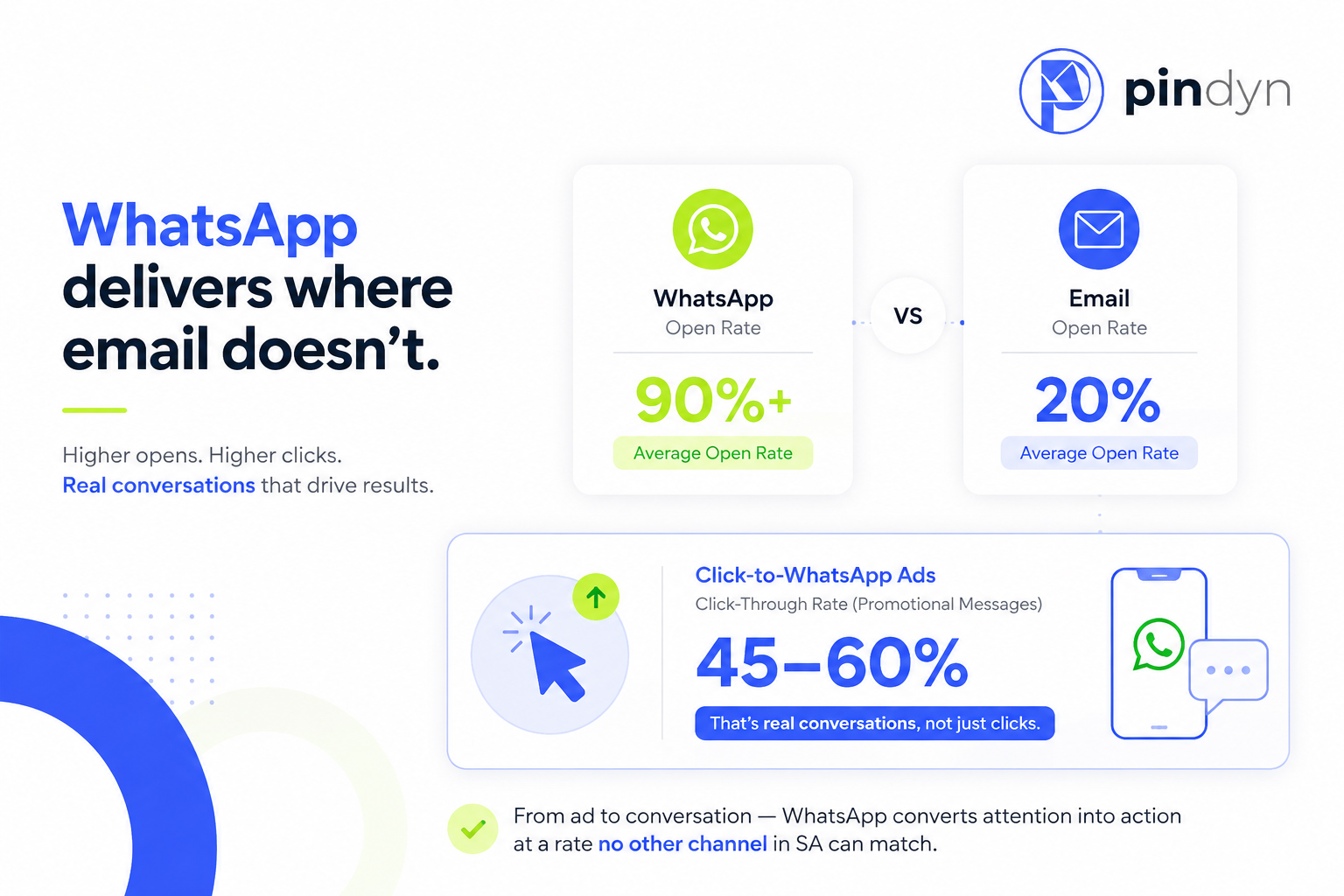
This is the part that actually answers the question. Higher open rates and higher click-through rates aren’t vanity metrics — they’re the earliest stages of the sales funnel, and WhatsApp is currently outperforming other channels at both. More conversations started means moreopportunities for a sale, provided the business on the other end is set up to make the most of them.
Why This Shift Matters for How You Sell
None of this means every business needs to abandon other channels. It means customer expectations have shifted, whether a given business has caught up or not. A customer who messages a business on WhatsApp today generally expects a fast reply, a real conversation rather than a static form, and the ability to keep chatting instead of being redirected to email or a phone call.
Businesses that are set up to meet that expectation are converting more of these enquiries into actual sales. Businesses still treating WhatsApp as an afterthought — checked once in the morning, once at lunch, once before closing — are quietly losing leads to competitors who reply within minutes.
We covered the underlying question of whether a business actually needs a dedicated WhatsApp bot in more detail in an earlier article: Do I Need a WhatsApp Bot for My Business in 2026? That piece is worth reading if you’re still deciding whether this applies to you. The short version: if a meaningful share of your enquiries already arrive on WhatsApp, the question isn’t really “if” anymore, it’s “how well.”
What “Doing More Business on WhatsApp” Looks Like in Practice
For most South African businesses, this shift shows up in a few concrete ways:
- More enquiries arriving after hours and over weekends, when nobody is watching the app
- Sales conversations that used to happen over email or phone now starting, and often finishing, entirely on WhatsApp
- Customers expecting order updates, quotes, and confirmations to come through chat rather than email
- Marketing and advertising increasingly built around a WhatsApp click, not a landing page form
None of this is a future trend to prepare for. It’s already how a large share of your customers are trying to reach you today.
More Conversations Don’t Automatically Mean More Sales
Here’s the catch: the data shows WhatsApp is generating more conversations and more opened messages than other channels. It doesn’t guarantee those conversations turn into sales. That part still depends entirely on what happens after someone messages your business — how fast you reply, whether the inquiry gets captured properly, and whether it reaches the right person before the customer loses interest and messages someone else.
This is exactly the gap between businesses that talk about “doing more business on WhatsApp” and businesses that can actually prove it in their numbers.
How PinDyn Helps You Convert That Volume Into Sales
PinDyn builds the layer that sits behind your WhatsApp number — capturing every enquiry, qualifying leads automatically, routing them to the right salesperson, and logging everything so you can see, in hard numbers, how many WhatsApp conversations are actually becoming customers. Instead of hoping the extra volume is helping, you get to see exactly what it’s worth.
Want to see what this looks like for a real business? Try our WhatsApp bot demo and message us directly on WhatsApp.